
Share this Story


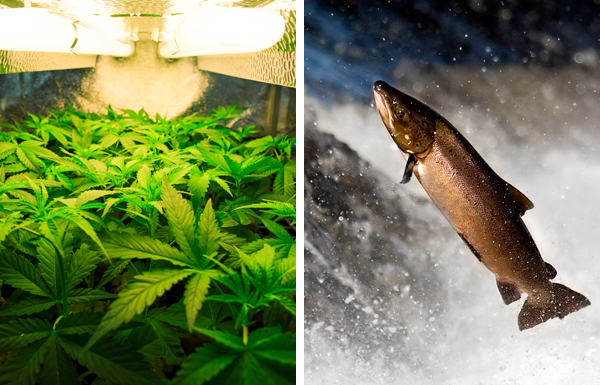
Marijuana vs. Salmon? Climate Change May Be Forcing Tough Choice
A perfect storm is converging on the tribes of the “Emerald Triangle,” the name given to the three counties – Humboldt, Mendocino and Trinity – in Northern California where much of the country’s marijuana is grown, hidden under canopies of trees. After four years of drought, the worst in California’s history, a State Department of Fish and Wildlife report published in March found that illegal marijuana grows have been using hefty portions of scarce river water in those counties, threatening both water resources and salmon habitats. Meanwhile, the U.S. Department of Justice has signaled to federally recognized tribes that under certain guidelines tribal cannabis cultivation and sales will not be prosecuted.
For many tribal members the option of going into the cannabis business is a choice between economic growth and maintaining salmon habitats.
Yurok tribal chairman, Thomas P. O'Rourke Sr. told ICTMN that a marijuana plant, “takes a lot of cold water from the Klamath River. One plant takes three gallons of water per day and the plant’s life is five months. That’s 450 gallons for one plant – 1,000 plants a small number, is 450,000 gallons. Multiply that by hundreds and cold water destined for our rivers is diverted and the adverse effects on our resources is a major issue. [Illegal grows] not only detour water from river but use poisons for pest eradication (varmints). Poison then enters back into spring.”
Both the Yurok and Hoopa tribes have taken part in raids on illegal grows with federal and state agencies, eliminating tens of thousands of marijuana plants. In a Los Angeles Times article last year about the raids, Josh Norris, a Yurok tribal member said, “There are elders living near some of these grows with no telephone and without reliable transportation, and they’re scared.”
O’Rourke told ICTMN, “Because of our resources, unsavory people have been brought into our lands and our women and children are no longer able to gather basket materials and foods, people with guns point at our children and women. Staff can’t do jobs because of illegal pot growers out there.”
In fact, biologists and foresters working with the Hoopa tribe were fired upon while conducting nighttime spotted-owl surveys. After the tribe alerted the police, helicopter reconnaissance discovered an illegal grow about a mile long.
Some tribal leaders see things differently: former Hoopa tribal chairman, Clifford Lyle Marshall wrote an editorial in a local paper urging the Hoopa tribe to repeal Title 34, the Marijuana Cultivation Suppression Ordinance, which allows the tribe to search and seize property, impose fines, and banish tribal members for cultivation of marijuana.
Marshall noting that the tribe was once blamed for killing the salmon in the 1970s, stated, “Nothing that the marijuana gardens may have used is comparable to the hundreds of thousands of acre-feet of water diverted to the Central Valley Project, and it does a disservice to the issue of environmental protection to simply blame a scapegoat... Permitting our citizens to grow on their property eliminates the reason people grow in the mountains, which is to hide. Legitimate farmers won’t have to hide if they can farm their own land. For this economically depressed community, the decision of the DOJ is nothing less than providence.“
On April 28, the Hoopa tribe in Humboldt County voted down a measure 534 to 308 to repeal Title 34 that makes marijuana production illegal on the reservation. Lisa Sundberg, a Yurok tribal member and cannabis entrepreneur told ICTMN, “They missed the opportunity to regulate it. All of these tribes have bars and sell alcohol. Every one of these Rancherias has some kind of alcohol and cigarettes they sell in their retail shops. This needs to be put in proper perspective, and regulation is the answer.”
She points out that regulations would weed out irresponsible growers and ensure that cannabis cultivation occurs only where there is adequate water. “That will only happen when there are rules that everyone understands what they are. Nobody knows now. As long as there are no requirements for anyone to do, all of these practices are going to continue. Bad behaviors are ongoing because these guys did not regulate and chose to go zero tolerance so they are going to all underground, and you can’t distinguish between bad actors and responsible ones.”
She notes that out of a 134,000 population in Humboldt County the number of grows, 14,000, is a huge engagement. A Vice investigation last year asserted nearly a fifth of Humboldt’s population is engaged in marijuana production.
Sundberg urges tribes to legitimize the industry and institute responsible zoning. “Tribes are not making a dime off of anyone that’s growing,” she says, “Eradication is a band-aid and it would cost them more money than if they regulated it. And it criminalizes tribal members: there is nothing else to grow.”
Tribal laws not only criminalize growers but also tribal members who are cancer patients with medical prescriptions legal in the rest of the state of California. She contrasts that with the heavy use of prescription opioids on the reservation that are given out by the Indian Health Service. Native Americans have the highest rates of prescription opioid addiction. Interestingly, recent studies have found that cannabis can help with getting off of opioids.
In the southern part of the Emerald Triangle in Mendocino County, the Pinoleville Pomo Nation stands apart from its neighbors in developing the first and largest indoor grow facility in Indian country. As reported by ICTMN in January, they have partnered with Kansas-based Foxbury Farm and United Cannabis out of Colorado to build a $30 million grow facility.
Sundberg notes, “Humboldt County has the best product and most experience in the country. Sixty years of growers and its product is tried and tested and is the international brand of medical marijuana in the world. Out of that has to come best practices. We need leadership in Indian country to set the pace to building this framework.”

You need to be logged in in order to post comments
Please use the log in option at the bottom of this page


Comments
This article is hard to
"Interestingly, recent
Many of tributaries used in
Many of tributaries used in